
Is Piano Harder than Guitar? What Beginners Need to Know

Is Piano Harder than Guitar? What Beginners Need to Know
Many students who are thinking about music lessons ask the same question: Which one is harder — piano or guitar?
The truth is that neither instrument is universally “harder” than the other. The right choice depends on a student’s goals, interests, and learning style. At Wisconsin Conservatory of Music, we help students explore both paths every day.
Both instruments are incredibly popular and are a great way to learn music. Some students picture themselves playing piano at home or performing classical pieces, while others imagine strumming a guitar with friends or joining a band.
There is no right answer, but understanding how piano and guitar differ can help students and families decide which instrument might be the best place to start.
Is Piano Harder than Guitar for Beginners?
For many students taking up an instrument for the first time, piano can feel a little easier in the beginning. One reason is that the piano produces sound immediately. Press a key and you hear a clear, steady sound. Students can put all their focus on learning rhythm and reading music.
The keyboard layout also makes it easy to visualize the music. Notes move from low to high in a straight line across the keys, and the repeating pattern of black and white keys helps students recognize scales and chords more quickly.
Many beginners, young and old, enjoy starting with piano lessons to build a strong foundation in reading music, technique, and musical expression.
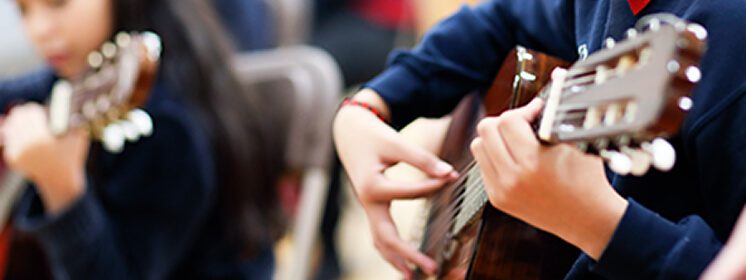
Guitar lessons are a different kind of learning experience. Producing a clean sound requires coordination between both hands. One hand presses the strings on the fretboard while the other strums or plucks them. While many students are motivated to learn to play the guitar and welcome this challenge, others see it as an obstacle to learning how to play music.
Beginners at the guitar also need time to build finger strength. Guitar strings can feel stiff at first, and it may take a few weeks for students to develop the pressure needed to avoid buzzing sounds. Through practice, students begin to feel more comfortable with the guitar and take pride in their growth.
How Piano and Guitar Feel Different to Play
Both piano and guitar require coordination, but they challenge musicians in different ways.
On the piano, students learn to use both hands independently. One hand might play a melody while the other supports it with chords or bass notes. As students progress, they develop the ability to balance these parts while reading more complex music.
Guitar divides those responsibilities differently. One hand forms chord shapes or individual notes along the fretboard, while the other controls rhythm through strumming or picking patterns.
For younger beginners especially, stretching fingers across the fretboard can be challenging at first. However, once they become comfortable with a few basic chords, they can string them together to play familiar melodies.
Understanding Music Through the Instrument
The layout of an instrument can influence how students understand music.
On a piano, notes move from left to right across the keyboard, making the correlation between pitch and movement very clear. This is very helpful when learning scales, chords, and basic music theory.
Guitar works a little differently. The same note can appear in several places across the fretboard, which gives guitarists flexibility but can feel less intuitive for beginners.
Reading music also looks different for each instrument. Piano students usually learn traditional notation from the beginning, while guitar students may start with chord charts or tablature that show where to place their fingers.
Practical Differences: Space and Portability
Beyond the learning experience, a few practical factors can come into play for a family or individual musician.
Pianos take up more space in the home and are a larger investment. However, many beginners start with a digital keyboard, which is more compact, affordable, and easy to fit into a bedroom or living space. Keyboards can also be used with headphones, making them ideal for shared spaces or apartment living.
Guitars are smaller, lighter, and highly portable. Students can easily bring them to lessons, rehearsals, or informal jam sessions with friends. Because of that flexibility, guitar often fits well into busy schedules and social music settings.
For many families, these practical details — space, budget, and how easily the instrument fits into daily life — can play an important role in deciding where to start.
Musical Style Often Matters Most
In many cases, the biggest deciding factor is simply which instrument a student feels most excited to play. When students love the sound of an instrument, they are much more likely to practice and continue learning.
The piano plays a central role in classical music, jazz, film music, and composition. Because of its wide range, a pianist can play melody, harmony, and bass all at the same time.
Guitar has a strong presence in rock, folk, blues, pop, and country music. Its portability and expressive sound make it a favorite for bands, singer-songwriters, and casual playing with friends.
At Advanced Levels, Both Instruments are Challenging
While piano can feel a little more straightforward in the beginning, both instruments can become highly demanding as students advance.
Pianists learn to coordinate complex rhythms between both hands, navigate wide movements across the keyboard, and shape music through dynamics, phrasing, and pedal control. As repertoire becomes more advanced, pieces often require both technical precision and deep musical expression.
Guitarists face their own set of challenges at higher levels. Players develop faster picking techniques, more complex chord voicings, and expressive elements such as bends, slides, and vibrato. Many styles also require strong rhythmic control and the ability to switch smoothly between chords, melodies, and accompaniment patterns.
In other words, neither instrument stays “easy” for long. As students grow, both piano and guitar offer new technical challenges and creative possibilities. That ongoing process of learning and growth is part of what keeps music engaging for years to come.
Start Your Musical Journey at Wisconsin Conservatory of Music
There is no single “right” choice. The best instrument is the one that sparks curiosity and makes a student excited to practice.
If you’re deciding between piano and guitar, you don’t have to make the choice alone. At Wisconsin Conservatory of Music, our experienced faculty work with students of all ages to help them explore instruments, build confidence, and develop a lifelong love of music. Contact WCM today to discover the instrument that inspires you most.